
Bronx Court Records After Arrest
Bronx County court records after a jail arrest usually form after police processing and the first court appearance. NYPD or another arresting agency handles the arrest and early processing. NYC Criminal Court handles misdemeanors, lesser offenses, arraignments, and preliminary hearings for felonies. If the court remands the person or sets bail that is not paid, the person can be committed to the New York City Department of Correction and may then appear in the citywide DOC lookup.
The court record is different from the custody record. The DOC entry may show current location and basic case information, but the formal criminal case belongs to the court and prosecutor path. For current custody and booking identifiers, use Bronx County jail inmate records. For booking photos and the limits on public mugshot access, use Bronx County jail roster mugshots. Court records after an arrest focus on filed charges, future appearances, warrants, bail decisions, dismissals, reductions, indictments, and dispositions.
Search Bronx Court Records After Arrest
Pending criminal case information and future appearances are searched through NY Unified Court System WebCriminal and related E-Courts tools. The court system describes WebCriminal as a free way to search criminal cases with future appearance dates in selected New York criminal courts. It also warns that some cases can be delayed in updates, so a missing result does not always mean there is no Bronx County court record after the arrest.
The WebCriminal entry page shows the main court search paths for a Bronx County arrest case:
| Search Option | Type | Required | How It Helps |
|---|---|---|---|
| Case Identifier | Search path | Depends on path | Search by case number or summons number when the identifier is known. |
| Defendant Name | Search path | Depends on path | Search by first and last name, or by corporation name for entity cases. |
| Court Calendar | Search path | Depends on path | Generate a calendar by court part or judge in Supreme and County Court paths. |
| WebCriminal Mobile | Link | No | Use the mobile version when checking future appearances from a phone. |
The screenshot from the official WebCriminal welcome page shows the court search choices used after a Bronx County arrest.
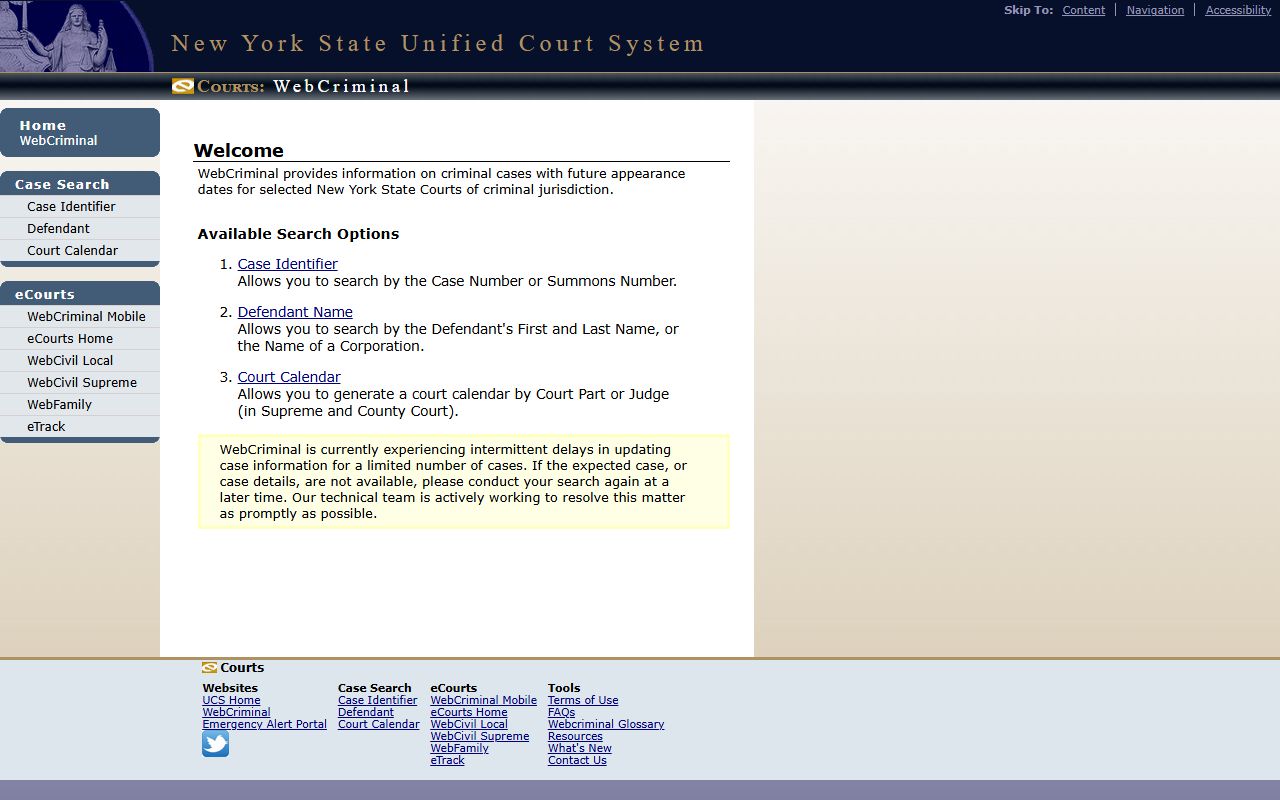
Use WebCriminal for the court side of the case. Use the DOC lookup only to confirm whether the person is in city jail custody.
Bronx Arrest to Court Records
The arrest to court pathway can move fast, and each step may sit in a different system. A Bronx County court record after arrest is not the same thing as an NYPD arrest report, a DOC booking entry, or a state prison record. The formal case begins in the court and prosecutor channel, while jail custody begins only if the court orders detention, remand, or bail that is not posted.
- Police processing starts with NYPD or another agency. Early arrest records and police reports are usually requested through NYPD records channels or NYC OpenRecords, subject to exemptions.
- NYC Criminal Court conducts arraignments. Misdemeanors and lesser offenses stay in Criminal Court, while felony matters may start there for preliminary steps.
- The Bronx County District Attorney decides how state charges are prosecuted. Formal charges may differ from the arrest allegation or the initial booking summary.
- The court makes a securing order. The person may be released on recognizance, released with non-monetary conditions, assigned bail where allowed, or remanded when the law permits it.
- If detention follows, DOC custody can begin. The person may then appear in the NYC DOC lookup with current location and basic case information.
- Search WebCriminal by defendant name or case identifier. If no result appears, check spelling, allow for update delay, and consider sealed status, no future court date, or transfer to another jurisdiction.
Bronx County court records after an arrest should be read as court data, not as a full arrest file. A docket or WebCriminal result may show the charges and next date, while a police file may contain arrest narratives, property information, or investigative material that is not posted online.
Bronx Arrest Court Charging Records
Charging records explain why the court case exists. The language can be terse, but the document type matters. A complaint can start a case at arraignment. An information is a misdemeanor accusatory instrument that can proceed in Criminal Court when legally sufficient. An indictment is a grand jury accusation that generally moves a felony prosecution into Supreme Court.
| Document | Common Use | Who Creates It | What to Check |
|---|---|---|---|
| Complaint | Initial accusatory instrument, often used at arraignment. | Filed through the prosecution path, often based on police allegations. | Top charge, factual allegations, arraignment charge list, and next court date. |
| Information | Misdemeanor instrument that can support a Criminal Court prosecution. | Prosecutor or authorized filing party under court rules. | Whether the complaint has been converted and whether the charge can proceed. |
| Indictment | Grand jury accusation, usually for felony prosecution in Supreme Court. | Grand jury after presentation by the District Attorney. | Indictment number, felony counts, Supreme Court part, and later charge changes. |
Initial arrest allegations can be broader, narrower, or simply different from the filed court charges. That is why the court record after a Bronx County jail arrest should be checked after arraignment and again after any felony transfer, indictment, plea, reduction, or dismissal.
Bronx Arrest Charge Court Records
Charge status tells whether the accusation is still active and how it changed. A charge can be pending at arraignment, amended by the prosecutor, reduced during negotiation, dismissed by the court, or replaced by an indictment. The DOC record may lag or show only basic case information, so WebCriminal, E-Courts, and the court clerk are the better sources for formal Bronx County court records after arrest.
| Status | Plain Meaning | Record Caution |
|---|---|---|
| Pending | The charge is active and the case has not reached a final outcome. | Check the next appearance and court part before relying on an older printout. |
| Amended | The charge wording, count, or legal theory changed after filing. | Compare the current court charge to the initial arrest allegation. |
| Reduced | The charge level or count was lowered, often during case negotiation. | A booking entry may still show the older accusation. |
| Dismissed | The court ended that charge or case without a conviction on that count. | Sealing may affect public access after an eligible dismissal. |
| Indicted | A felony accusation moved by grand jury action, usually to Supreme Court. | Search by the newer case identifier if the Criminal Court path stops updating. |
Note: A charge is an accusation. It is not proof that the person committed the offense.
Bronx DA Court Records After Arrest
The Bronx County District Attorney's Office is the prosecution office for state criminal cases in Bronx County. The office is led by District Attorney Darcel D. Clark. Her official biography states that she became the 13th District Attorney for Bronx County on January 1, 2016, was re-elected to a third term in November 2023, and created or enhanced offices that include the Conviction Integrity Bureau, Public Integrity Bureau, Rikers Island Prosecution Bureau, victim services, and Community Justice Bureau work.
The official Bronx DA biography page is useful background when a court record after arrest involves DA policies, charging review, or bureau contact routing.
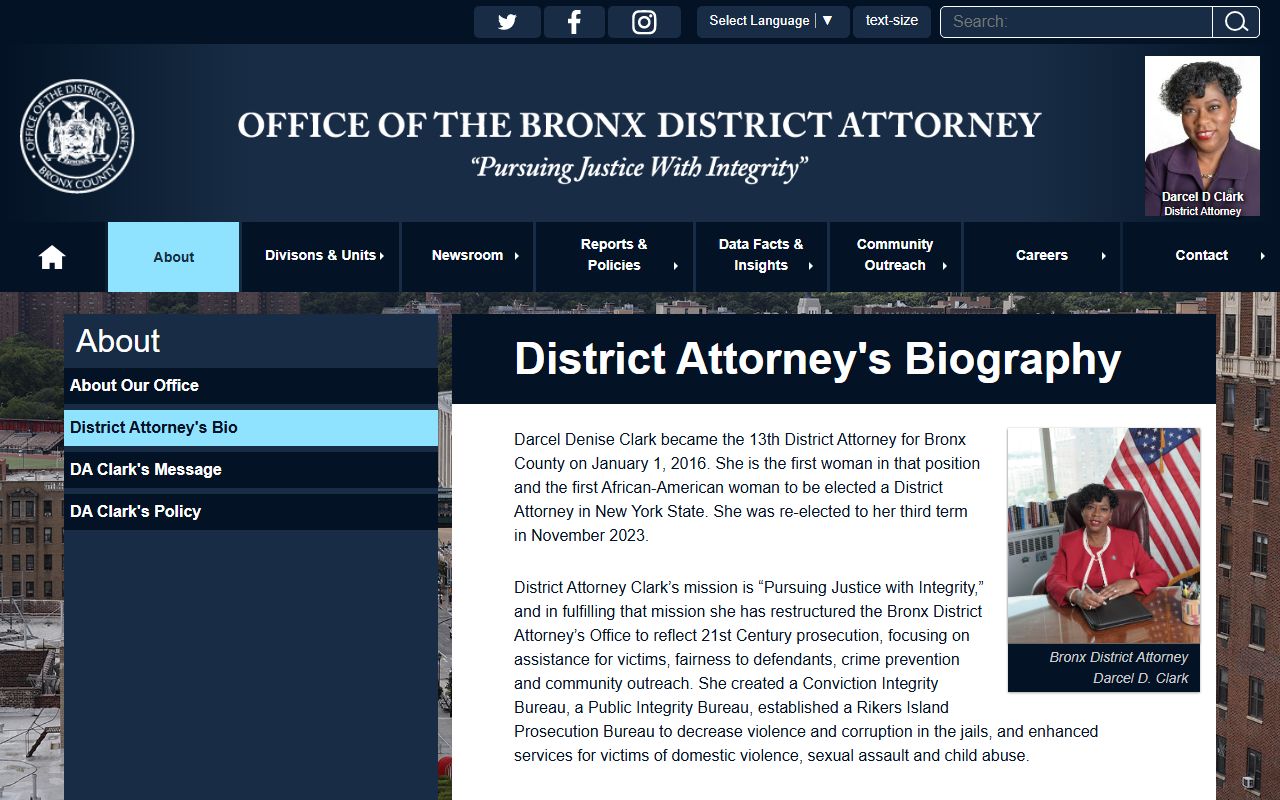
Prosecutor information does not replace a court docket, but it helps explain which office handles formal charging decisions after a Bronx arrest.
| Bronx DA Contact | Phone | Use |
|---|---|---|
| Main office | 718-590-2000 | General Bronx County District Attorney contact. |
| Arraignments / Complaint Room | 718-838-6651 | Complaint-room and arraignment-related prosecution contact. |
| Rikers Island Prosecution Bureau | 718-838-7270 | Jail-linked prosecution issues connected to Rikers Island cases. |
| Trial Division | 718-838-7301 | Trial prosecution matters after a case moves beyond arraignment. |
| Conviction Integrity Bureau | 718-838-6141 | Conviction review issues after a final case outcome. |
The Bronx DA contact page lists bureau numbers, office contacts, and the mailing address used by the prosecution office.
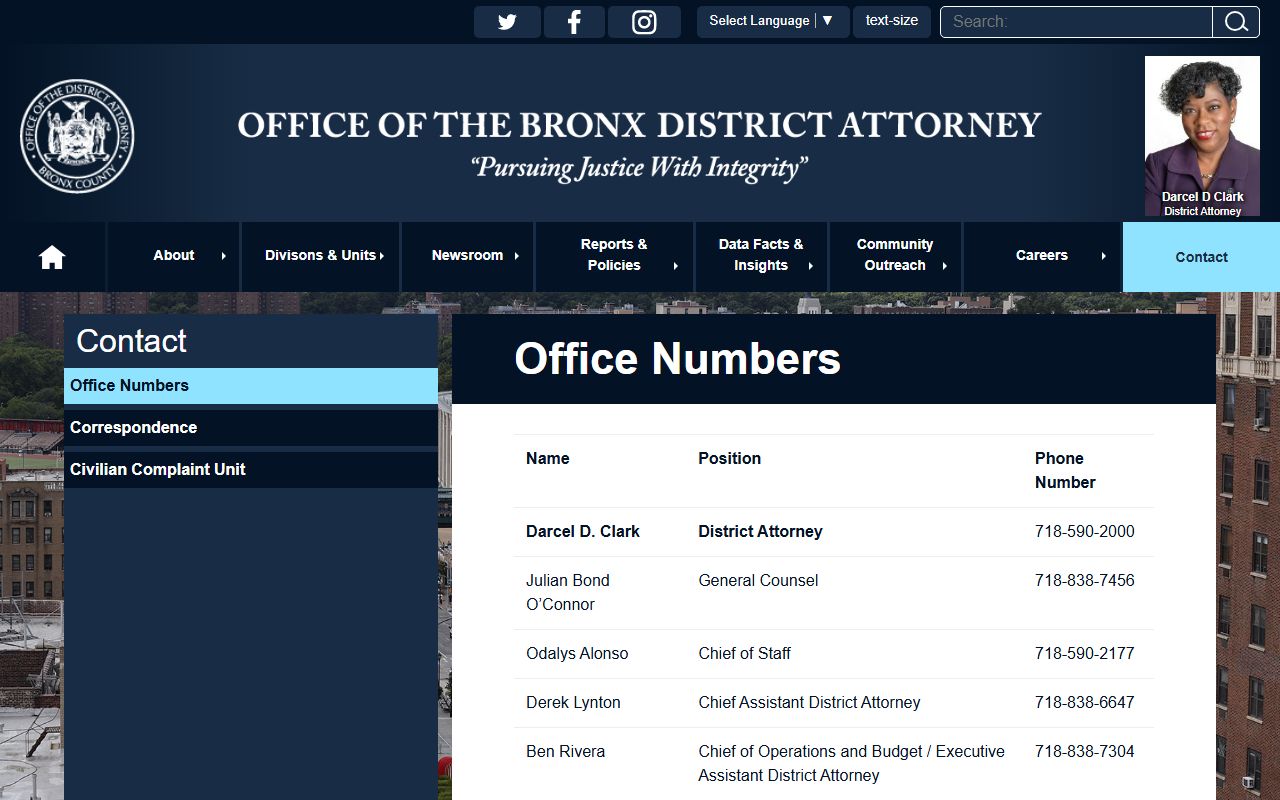
Use the DA contact list for prosecution-office routing. Use WebCriminal, NYC Criminal Court, or the court clerk for court record entries and docket access.
Bronx Bail Court Records After Arrest
New York uses a securing-order framework, not a simple county bond schedule. Under Criminal Procedure Law section 510.10, the court considers risk of flight, the person and charges, prior record, firearm history, harm allegations, and financial circumstances when money bail is allowed. Bronx County court records after a jail arrest may show release on recognizance, non-monetary conditions, bail, remand, or later changes to those terms.
The NYC DOC bail page says bail must be paid in full and in person, and online bail payment is unavailable. DOC calls people who pay bail sureties. Personal identification and the NYSID or Book and Case Number are required.
| Bail Item | Bronx County Detail | Record Use |
|---|---|---|
| Bronx Criminal Court payment window | Lower Level, Room M-05C, open seven days a week, 8 a.m. to 1 a.m. | Use after confirming the current court order and person identifier. |
| Rikers Island Central Cashier | Open 24/7 for DOC bail payments. | Useful when the person is in DOC custody and payment must be made outside court hours. |
| Accepted forms | Cash, qualifying cashier's or teller's check, qualifying money orders, and credit or debit card. | The total must exactly match bail when mixed payment forms are used. |
| Not accepted | Personal checks, checks or money orders over stated limits, or forms requiring refund or change. | Rejected payment can delay release even when bail is otherwise posted. |
| Hold or detainer | Parole, state-ready transfer, federal custody, or immigration detainer issues may block release. | A paid bail amount may not produce release if another legal hold exists. |
Bronx Arrest Warrant Court Records
No separate Bronx County sheriff active warrant list was found in the official research sources. Warrant records should be routed through the court, NYPD, DOCCS parole channels, or federal authorities, depending on the warrant type. A bench warrant often comes from a missed court date. An arrest warrant authorizes police to take a person into custody. A parole warrant can lead to technical parole violator custody. A fugitive warrant may involve another county, state, or federal agency.
WebCriminal may show a case status and future appearance, but it is not a complete active-warrant database. NYC Criminal Court and the Bronx court clerk can answer case-specific public questions within access limits. NYPD may hold enforcement information that is not public while active. The U.S. Marshals Southern District of New York serves Bronx County for federal fugitive matters and publishes profiled fugitives and a tip line.
Bronx Arrest Court Records: Charges vs Convictions
A Bronx County court record after arrest may show a charge long before it shows a conviction. The difference is central. A charge is the accusation filed in court. A conviction is the outcome after a guilty plea, verdict, or other qualifying final disposition. A dismissed charge, reduced count, or sealed case should not be read the same way as a conviction record.
| Point | Charge | Conviction |
|---|---|---|
| Stage | Filed after arrest or during prosecution. | Entered after plea, verdict, or qualifying final outcome. |
| Meaning | An accusation that must still be proved or resolved. | A final finding or admitted offense unless later vacated. |
| Where seen | Complaint, information, indictment, docket, or WebCriminal entry. | Disposition and sentence records in the court file. |
| Risk in search results | May be mistaken for guilt if read without case status. | May still need context, such as sentence, appeal, or sealing. |
Sealed Bronx Arrest Court Records
New York public access rules make Bronx County court records after arrest available in many situations, but not all. Public Officers Law section 87 starts from public access to agency records, subject to exemptions. Public Officers Law section 89 adds FOIL procedures and privacy rules, including limits on arrest or booking photographs. Court sealing rules and criminal procedure rules can also restrict public access after certain dismissals or eligible outcomes.
New York practice is usually discussed in terms of sealing rather than broad expungement. Expungement means a record is erased or treated as if it no longer exists, but that is not the normal remedy for most Bronx criminal cases. Sealing means public access is blocked or limited, while some justice agencies may still have lawful access.
| Issue | Sealed | Expunged |
|---|---|---|
| Public view | Hidden from ordinary public court or agency access when sealing applies. | Removed or treated as erased in the narrow situations where law allows it. |
| New York use | The main term for many eligible dismissed or restricted criminal records. | Less common and not the default result after a Bronx arrest. |
| Agency access | Some courts, police, prosecutors, or justice agencies may retain limited access. | Access depends on the specific statute and record type. |
| Search impact | WebCriminal or public clerk searches may not display the case. | Public searches may not locate the record if the law fully removes it. |
Use NYC OpenRecords or the NYPD FOIL guidance for police or agency records when the online court path is not enough. Court docket copies are controlled by the court system, not by DOC.
Older Bronx Arrest Court Records
The NYC Criminal Court page lists the court information line at 646-386-4900 and explains that Criminal Court handles misdemeanors, lesser offenses, arraignments, and preliminary hearings for felonies. It also points users to E-Courts for adjourn dates and court location information. Older or closed Bronx County court records after arrest may require the court clerk rather than a live WebCriminal result, especially if there is no future appearance date.
If the case moved to Supreme Court by indictment, search under the later case identifier and court path. If the person moved from jail to state prison after sentencing, the court record stays with the court while custody information moves to New York State DOCCS. If the arrest involved a federal charge or immigration hold, federal custody channels may explain custody, but they do not replace the Bronx state-court case record.
Important: Search results are not consumer reports and may not be used for employment, tenant screening, credit, insurance, or another FCRA-regulated purpose.